October 11, 2026 · 6 min read
Rotted window sill: repair or replace, and how it is done right
By the D&E Mako Renovation crew, Ephrata, PA. General guidance, not a quote for your house.
A rotted window sill can be repaired with epoxy when the rot is small and shallow, roughly less than a tenth of the sill. Past that, the sill should be cut out and replaced. Replacement typically costs about $300 to $2,000 per window in 2026, depending on the material, the wall and whether the rot has spread into the window frame or the wall below. Sills are the most common place rot starts on a window, because they are the part that holds water.
 Lower Merion TwpSep 2025
Repair or replace: the quick test
Push a screwdriver or an awl into the sill, the corners and the bottom edge.
- Only a small soft spot, less than about 10 percent of the sill, with solid wood all around it: epoxy repair can work.
- Soft wood across a large part of the sill, or soft corners on both ends: replace the sill.
- Soft wood in the jambs above the sill, or in the window frame itself: the window may need repair or replacement too.
- Stains or soft spots on the wall or floor below the window inside: water has reached the wall, and the framing needs to be checked.
This rule of thumb comes from experienced restoration carpenters and is widely used. It is not exact, but it is a good starting point.
What it costs
| Job | Typical cost per window in 2026 |
|---|---|
| Epoxy repair of a small rotted area | $150 to $450 |
| Replace exterior sill in PVC, frame and wall sound | $300 to $900 |
| Replace sill and exterior trim | $500 to $1,500 |
| Rot into the window frame or wall framing | $1,000 to $3,000+ |
| Full window replacement instead | see our vinyl window cost guide |
These ranges come from national cost guides for 2026, which vary quite a bit. The biggest driver is how far the rot has gone.
Why sills rot
Sills are meant to shed water. When they hold it instead, they rot. The usual causes:
- Flat or back-sloped sills. Water pools instead of running off.
- Failed paint, especially on the top surface and the end grain.
- Caulk across the bottom edge, which traps water behind the sill.
- Gutters and downspouts dumping water on the window.
- Stucco or brick tight against the sill, so water wicks into the end grain.
- Window frame leaks that drain water onto the sill from inside the wall.
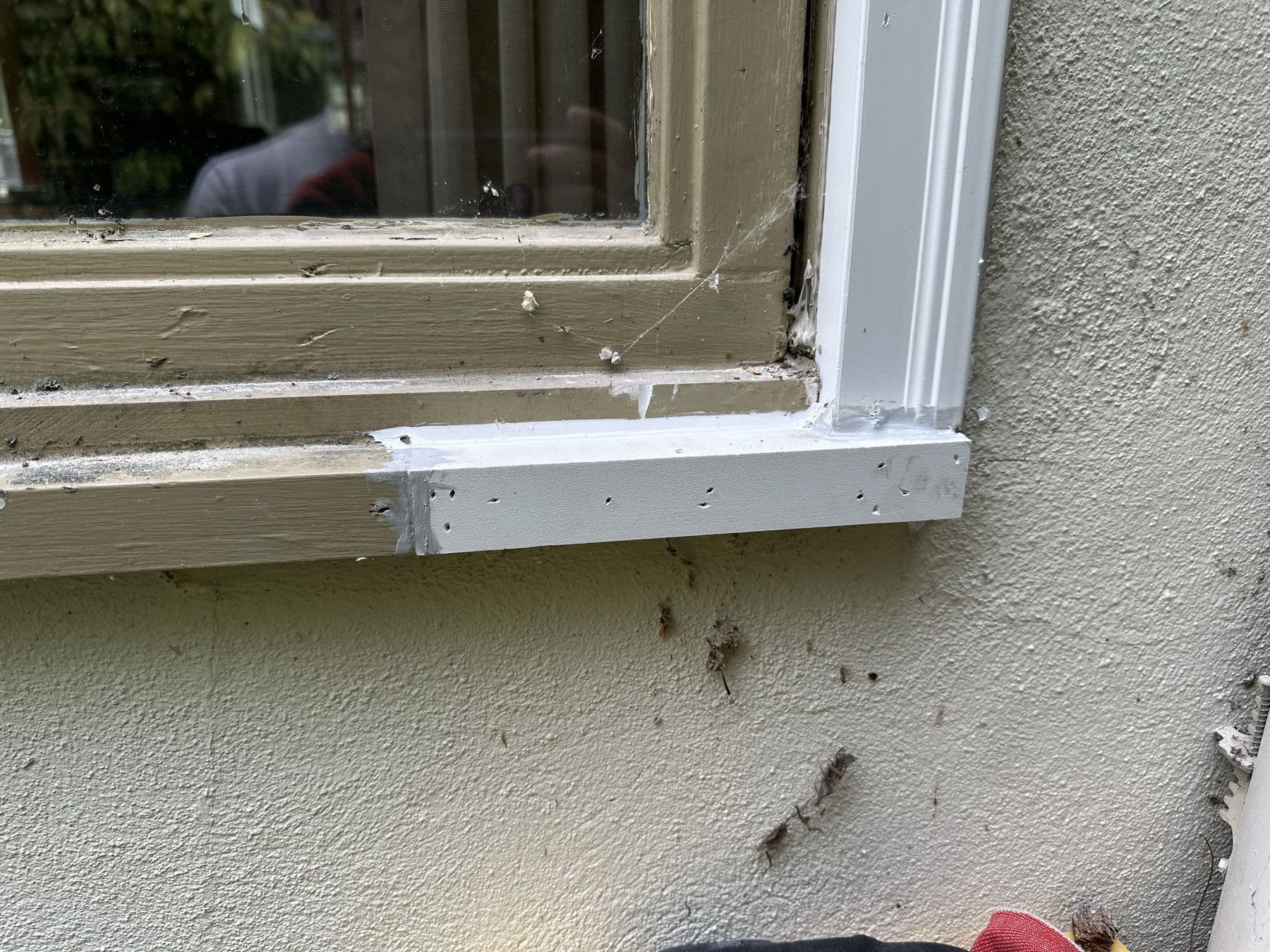
On a stucco house in Lower Merion, the sills had rotted at the corners where water sat against the stucco below a gutter downspout. That is the photo at the top of this page.
 Lower Merion TwpSep 2025
Epoxy repair, step by step
When the rot is small, epoxy can save the original sill. This is common on older wood windows that are worth keeping.
- Dig out all soft, decayed wood back to sound fibers.
- Let the wood dry fully. This can take days.
- Brush on a liquid epoxy consolidant that soaks into and hardens the remaining wood.
- Fill the cavity with an epoxy filler and shape it to match the sill.
- Sand, prime and paint.
Done well, an epoxy repair lasts many years. Done over wet wood or over rot that was not fully removed, it fails quickly.
Replacement, step by step
When the sill is too far gone, we replace it. This is how we did the stucco house in Lower Merion:
- Remove the exterior trim around the bottom of the window.
- Cut out the old sill carefully, without damaging the window frame or the stucco around it.
- Probe the frame, the wall sheathing and the framing under the sill, and replace any soft wood.
- Install flashing under the new sill so water that gets past it drains out.
- Fit a new sill, usually PVC, sloped to shed water and with a drip edge underneath.
- Reinstall or replace the exterior trim.
- Seal the joint between the new sill and the stucco or brick with backer rod and a flexible sealant, leaving drainage open at the bottom.
 Lower Merion TwpSep 2025
The old sill came out in pieces, with dark, soft wood under the window. The new PVC sill and trim went in with a proper joint to the stucco.
 Lower Merion TwpSep 2025
Choosing the sill material
- PVC does not rot and holds paint. It is our usual choice for exterior sills on painted houses.
- Rot-resistant wood, primed on all sides, suits historic houses or where a profile must match.
- Stone or precast sills sit under many brick windows. When those crack, they can be replaced. On the Douglassville brick house, the new windows sit on new stone sills.
Inside sills and stools
The flat board inside, which most people call the window sill, is technically the stool. It rots less often, but it can be damaged by condensation, plants and leaks from above. Replacing a stool is interior trim work, often done with new casing and an apron below.
Window sills on stucco and brick houses
Stucco and brick houses have extra sill problems:
- The masonry or stucco often sits tight against the sill with no gap, so water wicks into the wood.
- Old stucco may have no flashing behind it at the window.
- Cutting out a sill can crack the stucco if it is done carelessly.
We cut the sill free from the masonry first, protect the stucco edge and patch it after. New sills get a sealant joint that can move instead of a hard mortar joint.
When to replace the whole window
Sill repair makes sense when the window itself is good. Replace the whole window when:
- The sash or frame is rotted, not just the sill.
- The window does not open, close or lock properly.
- The glass seals have failed and you are replacing for comfort anyway.
- Several sills on the same side of the house are bad, which usually means a flashing problem across the wall.
Preventing sill rot
- Keep gutters clean and downspouts away from windows.
- Repaint sills every few years, including the end grain and the bottom edge.
- Never caulk the bottom edge of a sill to the wall.
- Check the bottom corners of sills every spring.
- Wipe up condensation inside in winter, and fix the humidity if it is heavy.
Lead paint
Most homes built before 1978 have lead paint on old sills. Removing or sanding them is covered by EPA lead-safe rules. The work must be done by a certified firm with containment and cleanup.
Permits and contracts
Sill repair and replacement do not need a building permit in Pennsylvania. Contracts for home improvement work over $500 must be in writing, with three business days to cancel.
When the water is coming from somewhere else
A rotted sill is sometimes a symptom, not the problem. If you replace a sill and it rots again, or if several sills on one wall are bad, look for these sources:
- A leaking window frame or failed glazing that drains water onto the sill from inside the window.
- No head flashing over the window, so water runs down behind the casing and collects at the sill.
- A roof-to-wall joint above without kick-out flashing, sending water down the wall.
- Gutter overflow from a clogged or undersized gutter right above.
- Water inside the wall behind stucco or siding that drains out at the first opening it reaches, which is often the window.
On the Lower Merion stucco house, a downspout right below kept the wall wet after every rain. If we replace a sill and see signs like these, we tell you, because a new sill on a wet wall will not last.
Questions people ask about rotted window sills
Can I just fill a rotted sill with wood filler? Standard wood filler over rot fails quickly. If the rot is small, use epoxy consolidant and filler after removing the soft wood. If it is large, replace the sill.
How long does sill replacement take? One sill usually takes a few hours to half a day, more if the frame or wall needs repair.
Will a new sill match my old windows? Yes. PVC sills can be cut to any profile and painted. Wood sills can be milled to match.
Why did my sill rot when the rest of the window is fine? Because the sill is where water sits. It is often the first and only part to rot.
Is the estimate free? Yes. We probe every sill, check the frame and wall, and give you a price per window.
See our exterior trim service, the rotted window sill repair project in Lower Merion and our exterior window trim replacement cost guide.