October 10, 2026 · 6 min read
Copper gutters: cost, lifespan and why they turn green
By the D&E Mako Renovation crew, Ephrata, PA. General guidance, not a quote for your house.
Copper gutters are common on stone houses on the Main Line and in Chester County, and on older farmhouses in Lancaster County. They cost several times more than aluminum, and they can outlast the house. This guide covers what copper gutters cost, how long they last, what happens to the color, and the installation rules that decide whether copper lasts sixty years or fails in ten.
 HaverfordNov 2024
What copper gutters cost
Copper is the most expensive common gutter material. Consumer cost guides put copper gutters at roughly $15 to $40 per linear foot, and some put installed copper at $30 to $50 per foot, which works out to several thousand dollars for an average house (NerdWallet, Inch Calculator). For a 100-foot run, a reasonable planning range is a few thousand dollars, with the final price set by the details below.
What moves the price:
- Profile. Half-round gutters with round downspouts are the traditional choice and usually cost more than K-style.
- Size and weight. Wider gutters and heavier copper (measured in ounces per square foot) cost more and last longer.
- Height and access. Two and three-story eaves need staging.
- Number of corners, outlets and downspouts. Each soldered corner and outlet takes time.
- Fascia repair. Old gutters often hide rotten fascia that has to be fixed first.
- Decorative parts. Leader heads, decorative brackets and hangers add cost.
How long copper gutters last
Copper gutters commonly last 50 years or more, and some last a century. The copper itself rarely fails. What needs attention over time are:
- Soldered seams, which can crack after decades of expansion and contraction.
- Hangers, which can loosen.
- Fascia behind the gutter, if water ever gets behind it.
Compared to aluminum gutters, which usually last 20 to 30 years, copper can be the cheaper choice over the life of a house you plan to keep.
Do copper gutters turn green?
Yes, eventually. Here is what happens to copper outdoors:
- New: bright penny color.
- Months to a couple of years: it darkens to brown and then a deep bronze.
- Many years: a green patina (verdigris) starts to form, first in patches.
- Decades: an even green or dark brown, depending on exposure, rain and air quality.
The timing depends on climate. Near the ocean and in polluted air, green comes faster. Inland in Pennsylvania, most copper stays brown for many years and greens slowly. Sheltered areas often stay brown.
The patina is not damage. It is a thin protective layer that slows further corrosion. If you want to keep the bright penny color, the copper has to be cleaned and sealed regularly, which most people stop doing after the first year.
One side effect: rain running off copper can leave green or blue-green stains on stone, concrete or light siding below. Downspouts that discharge onto pavement can stain it. Planning where water goes avoids most of this.
 HaverfordNov 2024
Half-round vs K-style
- Half-round: a semicircular trough, with round downspouts. The traditional look on older and historic houses. Hung with brackets or hangers.
- K-style: flat back with a decorative front that looks a bit like crown molding. Holds more water for its width and fits flat fascia boards easily.
On stone houses and historic houses we usually see half-round. On newer houses, K-style copper is less common but works.
Installation rules that decide how long copper lasts
Never mix metals
Copper must not touch aluminum or galvanized steel in the wet. The other metal corrodes quickly where they meet. Copper gutters need copper or stainless fasteners, copper hangers and copper downspout straps. Water running off a copper roof should not drain into aluminum gutters.
Solder, do not caulk
Copper seams, corners and outlets are joined by soldering. Caulk on copper fails within a few years.
Leave room to move
Copper expands and contracts with temperature. Long runs need expansion joints, and hangers must let the gutter move.
Pitch it right
Gutters should slope toward the outlets so water does not stand in them.
Protect the fascia
Drip edge at the roof edge sends water into the gutter, not behind it.
Copper flashing and small copper roofs
Copper is also used for:
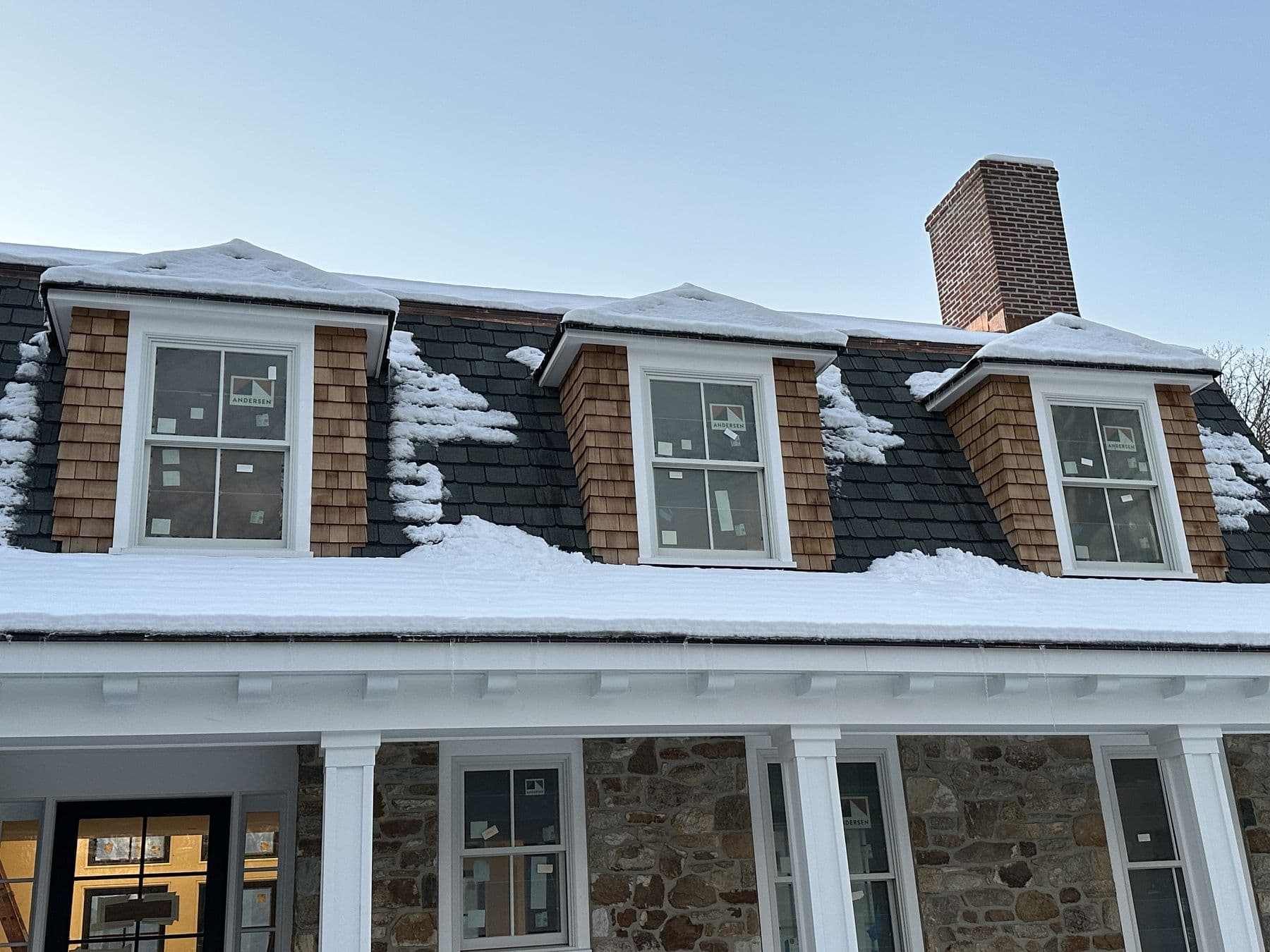
- Apron and base flashing where a wall rises out of a roof, like the copper we fitted under a bank of windows on a slate roof in Haverford.
- Step flashing along walls and chimneys.
- Small roofs over bay windows, porticos and dormers, often standing seam.
- Valleys on slate roofs.
These follow the same rules: copper fasteners only, soldered seams, room to move.
Is copper worth it?
Yes, usually, if:
- The house is stone, brick or historic, where copper fits the look.
- You plan to stay a long time.
- The roof is slate or another long-life material.
Probably not, if:
- The house has vinyl siding and asphalt shingles that will be replaced in 20 years.
- Budget is tight. Good aluminum gutters properly installed are a fine choice.
Faux copper
Copper-colored aluminum or steel gutters give the look for less. They will not develop a patina, and the coating can fade. They are a reasonable choice for looks only.
Taking care of copper gutters
- Clean leaves out once or twice a year, like any gutter.
- Look at seams and hangers every few years.
- Keep downspouts discharging away from stone and concrete you do not want stained.
- Do not use abrasive cleaners or bleach unless you want to reset the color.
Gutter guards on copper
Leaf guards can be used on copper gutters, and copper or stainless mesh guards match best. Avoid aluminum guards, for the same reason as aluminum fasteners: the metals react. Guards reduce cleaning but do not eliminate it, and some types make it harder to see a clog.
Leader heads and decorative parts
Leader heads, also called conductor heads, are the box-shaped collectors at the top of a downspout. On older houses they are both decorative and practical: they catch water from a gutter outlet or scupper and slow it before it enters the downspout. Copper leader heads with simple patterns or a date suit stone houses.
Other decorative parts include round downspouts with decorative straps, scrolled hangers and copper rain chains in place of downspouts on porches. Rain chains look good but splash more than closed downspouts, so they belong where splash does not matter.
Copper vs aluminum over thirty years
Aluminum gutters cost much less to install and commonly last twenty to thirty years. Copper costs several times more and commonly lasts fifty years or longer. On a house you will keep, copper can be the cheaper choice once you count one aluminum replacement, and it needs no paint. On a house you will sell in a few years, aluminum makes more sense.
Questions people ask about copper
Can I mix copper gutters with aluminum downspouts? No. Water running from copper onto aluminum corrodes the aluminum. If the gutters are copper, the downspouts, straps and fasteners should be copper too.
What thickness of copper should gutters be? Residential copper gutters are commonly made from 16 or 20 ounce copper (ounces per square foot). Heavier copper costs more and resists denting and sagging better on long runs.
Can copper gutters be repaired? Yes. Leaking seams can be cleaned and resoldered, dented sections cut out and replaced with a soldered patch, and loose hangers reset. Repairs blend in after the new copper darkens.
Will copper stain my stone or siding? It can. Runoff from copper carries a small amount of copper salts that can leave blue-green streaks on light stone, concrete and painted surfaces below. Directing downspouts into drains or onto gravel, and keeping gutters from overflowing, avoids most staining.
Is copper theft a concern? Copper has scrap value, and thefts of downspouts from vacant buildings do happen. On occupied homes it is uncommon. Downspouts fastened with straps at several points are harder to remove quickly.
Copper and slate go together
Slate roofs can last a century. Aluminum or galvanized flashing and gutters on a slate roof wear out long before the slate, and replacing them means disturbing the slate. That is why copper is the standard on slate: it lasts as long as the roof. On the Haverford house, the copper apron under the windows meets a slate roof for exactly this reason.
Planning a copper gutter job
- Check the fascia and roof edge first, and fix any rot.
- Size the gutters and downspouts for the roof area; large roofs need larger gutters or more outlets.
- Plan outlets so downspouts land where water can drain away from the foundation.
- Decide on half-round or K-style, and the hanger style.
- Plan where expansion joints go on long runs.
- Schedule the work in dry weather; soldering needs clean, dry metal.
See our copper work service and the copper flashing project in Haverford. If the fascia behind your gutters is rotten, read soffit and fascia repair.