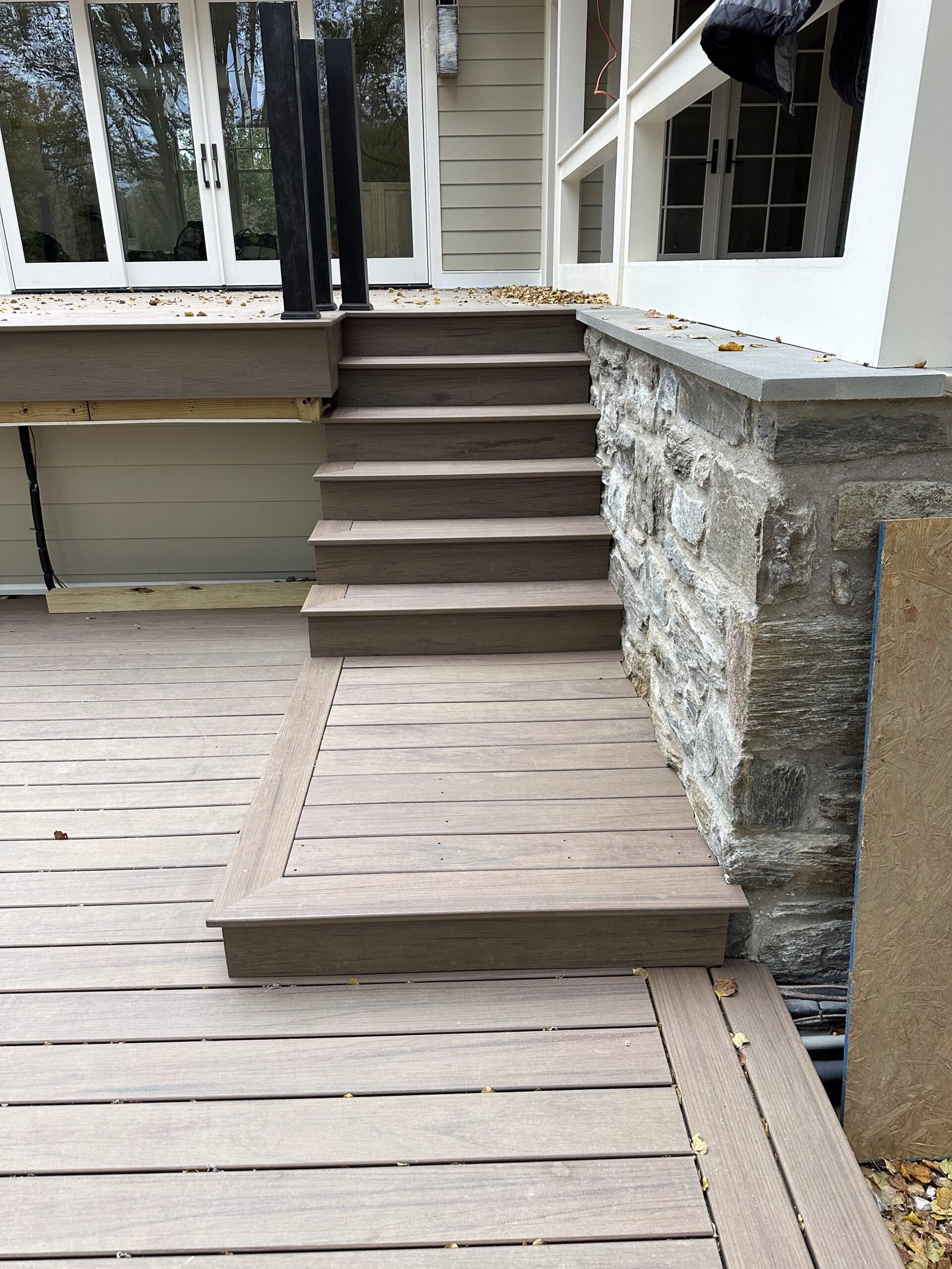

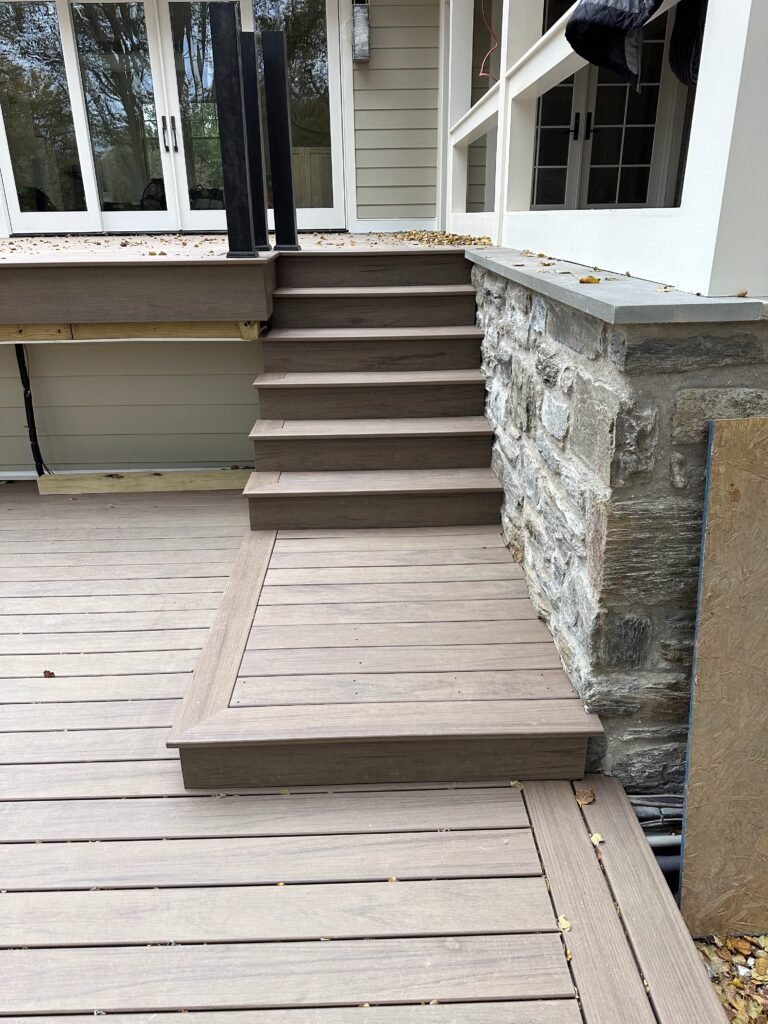
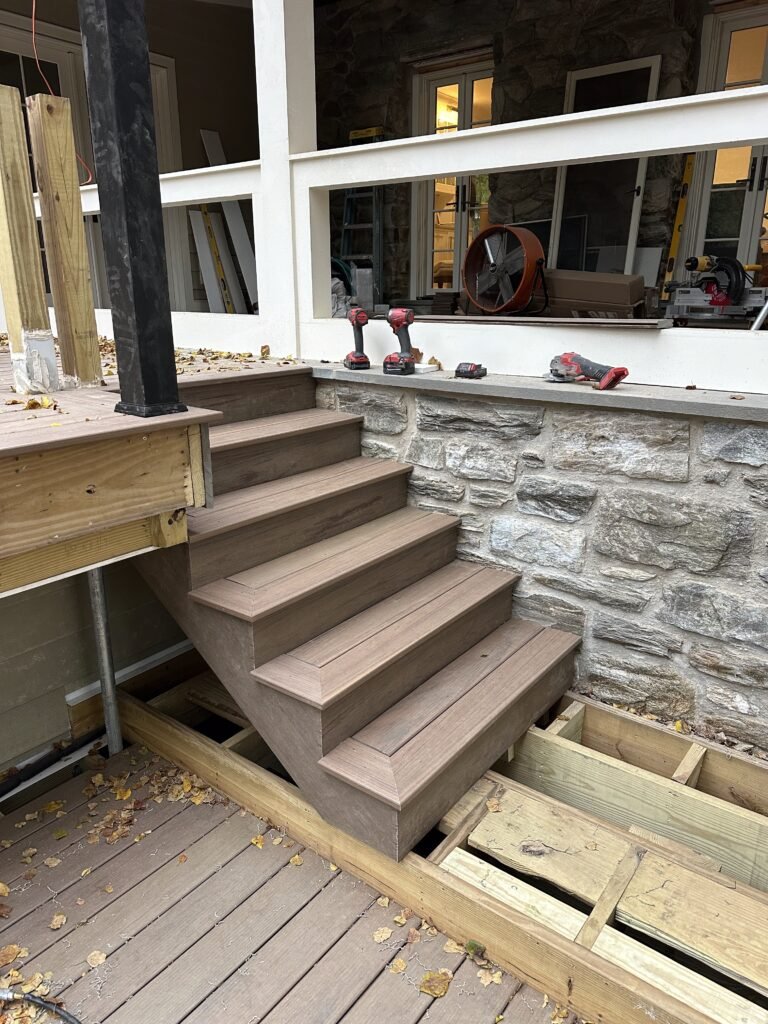
The photo above was taken mid-project. Composite treads and risers are already on, you can see the pressure-treated framing underneath, and there are still Milwaukee tools sitting on the steps. The bluestone-capped stone wall runs along the right side. Behind it you can make out the screened porch opening and the fiber cement on the back of the house.
We post photos at this stage on purpose. Once a deck is finished it looks the same whether the framing underneath it was done carefully or not. This angle shows the stringer layout, how the stairs land against the stone wall, and how the whole thing ties into the structure above. That is the stuff that actually determines how long it holds up.

What this project involved
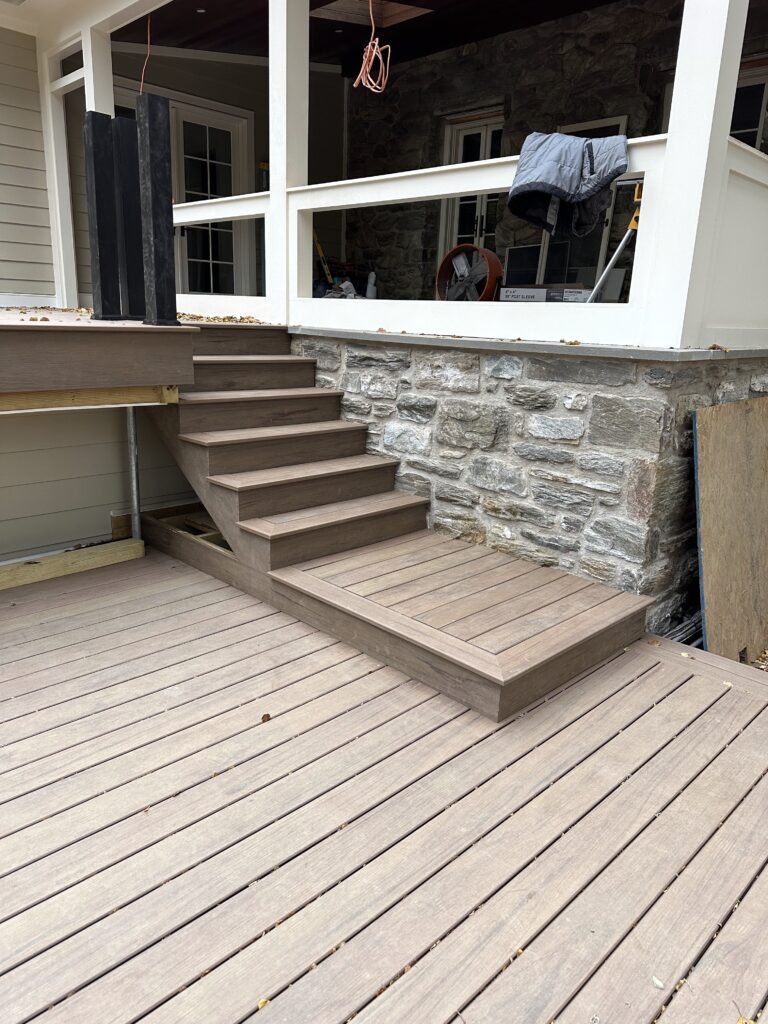
The house has a screened porch addition on the back, elevated above grade. The deck runs from that porch down to yard level, with the stair run going alongside the stone retaining wall on one side.
Work on this project included:
- Pressure-treated subframe and stringer construction for the full stair run
- Composite treads and risers in a warm brown throughout
- Black powder-coated post bases at the upper landing
- Fitting the stair layout against the existing stone wall and bluestone cap
- Tying into the screened porch framing above
The framing is pressure-treated throughout. That is not optional for anything close to ground contact in Pennsylvania. The composite surface sits on top of that frame and the two materials do different jobs, so both need to be right.
Composite or wood: the actual tradeoff
Almost every deck conversation starts here. The real answer depends on the homeowner and what they are willing to deal with over time.
Wood has a look and feel that composite gets close to but does not fully match. Some people care about that enough to take on the upkeep. A wood deck needs to be cleaned and sealed or stained every couple of years, and you want to check fasteners and board movement each season. A well-kept wood deck can look good for a long time.
Composite takes most of that maintenance off the table. It is wood fiber and plastic combined, and the capped versions that most manufacturers make now have a polymer shell that handles moisture, staining, and fading much better than older composite products did. You still need to clean it. You do not need to refinish it.
For most Lancaster County homeowners who want to actually use their deck without a spring project every year, composite makes more sense. The upfront cost is higher than pressure-treated wood, but over ten years the math tends to even out once you factor in materials and time for maintenance.
Trex, one of the more widely used brands, backs their higher-tier lines with a 25-year fade and stain warranty. TimberTech and Fiberon publish comparable coverage. The American Composite Manufacturers Association has more background on how composite materials are tested and what the standards cover.
Also on this site: Fiber Cement Siding Installation in Denver, PA gets into similar thinking about low-maintenance exterior materials for homes in this area.
Stairs are where most deck projects go wrong
Stairs are the hardest part of a deck build and also where you can see shortcuts most clearly after the fact.
The geometry has to be consistent from top to bottom. The International Residential Code sets maximum riser height at 7-3/4 inches and minimum tread depth at 10 inches. It also says no two risers can vary by more than 3/8 of an inch. That last rule is not there for paperwork reasons. Inconsistent steps are how people trip.
On this project the top and bottom conditions were fixed by the existing construction, so the stringer layout had to produce consistent geometry between two set points rather than ideal conditions. That takes more layout time before the first cut gets made.
The stringers are the part nobody talks about. Cut them wrong or set them out of level and the stairs flex underfoot, develop gaps between tread and riser as the framing moves with the seasons, and sound hollow in spots. Pressure-treated stringers on correct spacing, properly hung at the top and supported at the bottom, produce stairs that feel solid and stay that way. That is what you want.
Composite treads and risers also require specific fasteners, corrosion-resistant and driven to manufacturer specs, with spacing that accounts for the expansion and contraction the material goes through across a full Pennsylvania year.
Working alongside the stone wall
The stone wall with the bluestone cap is not just scenery in this photo. It is a fixed structure that shaped how the whole stair was laid out.
The stringer positions had to work around the wall face and the cap overhang. Bluestone cap is consistent in thickness and profile, so the stair edge could be fitted against it cleanly. The gap between the stair edge and the cap stays consistent from top to bottom, which requires attention during layout, not during installation.
That kind of coordination between new framing and an existing stone element is one of the clearer differences between contractors who have done this before and those who have not. On a flat open lawn the geometry is forgiving. Next to a fixed stone wall, everything has to be right the first time.
Permits in Lancaster County
Deck construction requires a building permit in most Pennsylvania municipalities, and Lancaster County townships vary in how they enforce it. Some require a permit for any deck. Others have size or height thresholds.
The permit matters beyond just compliance. The framing inspection that comes with it happens before the decking goes on, so someone other than the contractor gets eyes on the structural work while it is still visible. That is worth something even when you have a contractor you trust.
If a contractor tells you to skip the permit, ask yourself why they would rather not have an inspection.
Questions worth asking any deck contractor in Lititz or Lancaster County
Are you PA HIC registered? Check at the Pennsylvania Attorney General’s HIC Registry before anything else. Two minutes, and it immediately filters out contractors who should not be doing this work.
Do you pull permits? Ask directly. A vague answer is itself an answer.
Walk me through the framing spec. You want to hear pressure-treated throughout, with joist and beam sizing based on actual span tables. A contractor who can explain this has thought about the structure. One who jumps straight to talking about the decking surface probably has not.
What composite are you using and why? Capped versus uncapped composite is a real difference in performance over time. A contractor who can explain the distinction knows the materials. One who cannot is likely just buying whatever is available.
How are the stringers framed and supported? Material, spacing, top connection, bottom landing. The answers here tell you more about the quality of the stairs than anything else.
Lancaster County towns where we do deck and outdoor work
Lititz is the anchor here, but we build decks across the county. A few places where we work regularly and where there are not many contractors putting out content at this level:
- Manheim, PA – Just south of Lititz, a lot of older homes adding outdoor space
- Marietta, PA – Historic borough on the Susquehanna, older properties with site conditions that require actual design work
- Mount Joy, PA – Central Lancaster County, steady demand for decks and outdoor structures
- Elizabethtown, PA – Western edge of the county, mix of older and newer homes
- Strasburg, PA – Southern Lancaster County, historic character, outdoor projects often involve existing stone elements
- Quarryville, PA – Rural southern Lancaster County, limited contractor options in this area
We also work through Chester County and the broader region. Our services page covers the full scope, and the projects page has photos.
Where this one goes next
The framing gets inspected, then the remaining deck surface goes on and the railing system is installed. The screened porch above is already framed and enclosed. When it is done, the whole sequence from house through porch to deck to grade will be one continuous thing.
Finished photos get posted when we close it out.
If you have a deck project anywhere in Lancaster County, reach out and we will come take a look.
Related posts: