
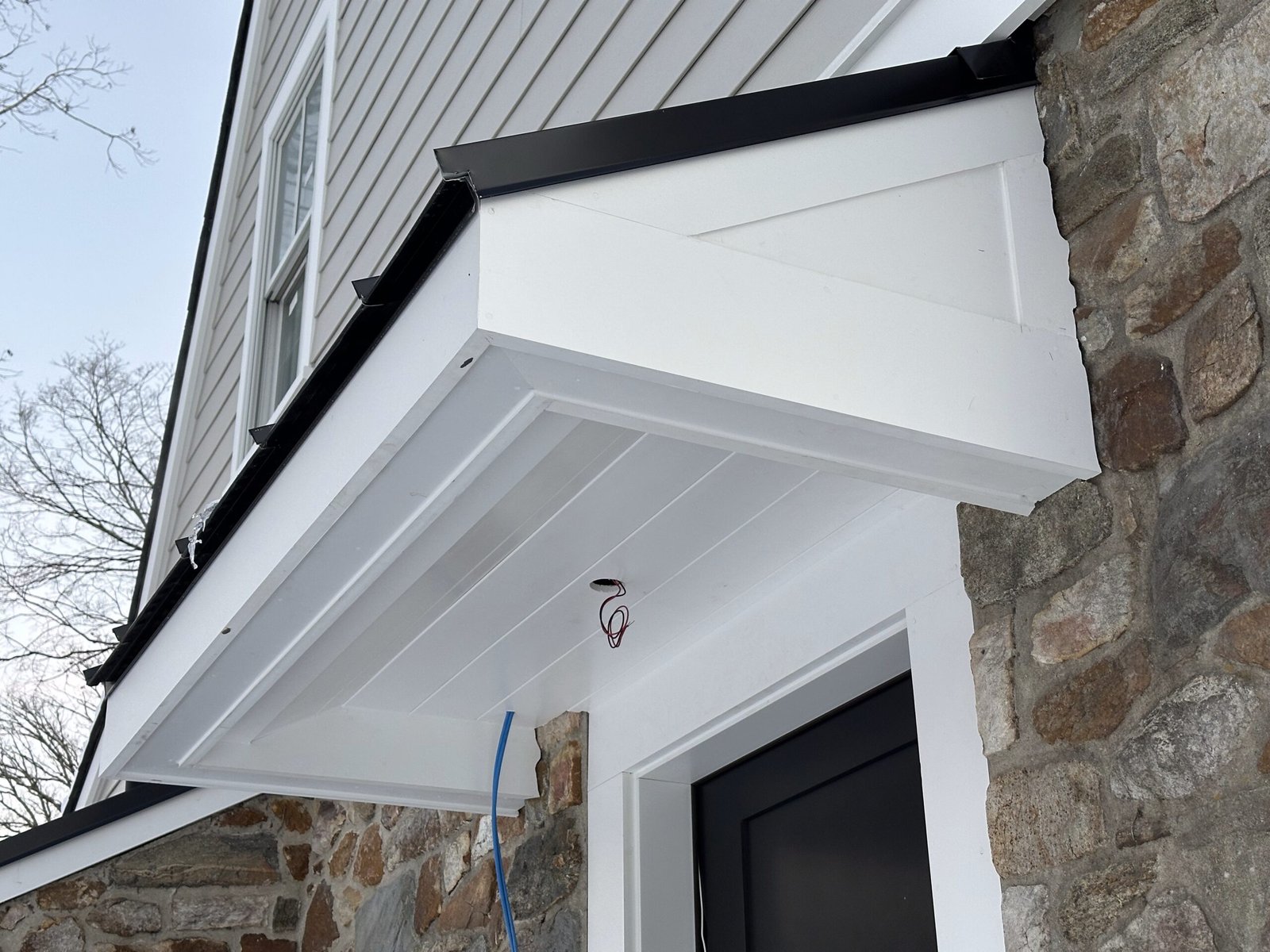

This is a custom entry portico on a stone home in Chester County, built for a project near Berwyn, PA. The photo shows the finished structure from below: white beadboard ceiling on the soffit, V-groove fascia panels with a decorative bracket at the corner, black metal drip edge across the top, and black gutters running the roofline. The electrical rough-in for the porch light is visible in the soffit ceiling, waiting on fixtures.
The stone wall behind it is original to the house. Everything else in this photo is new.
A portico like this one does several things at once. It keeps water off the entry, gives the front door a visual anchor on a large stone wall, and ties the new gray lap siding on the upper story to the stone below with trim details that read as intentional. None of that happens without thinking through how the structure connects to two different wall materials and what it needs to look like from the street.

What this custom entry portico in Berwyn included
The project was a full exterior renovation on a stone home in the Berwyn area of Chester County. The entry portico was one component of a larger scope that also included new lap siding on the upper gable and black gutters throughout.
The portico itself included:
- Structural framing tied into the existing wall assembly above the door opening
- White PVC beadboard ceiling panels on the soffit underside
- V-groove flat panel fascia with a decorative corner bracket
- Black painted metal drip edge along the top roofline
- Primed and painted trim throughout, including columns flanking the door
- Electrical rough-in for a recessed light in the soffit ceiling
PVC was the material choice for the beadboard and trim here rather than wood. On an exterior application that faces weather year-round, PVC holds up without the paint maintenance cycle that wood requires. It does not rot, does not absorb moisture at the edges, and does not require refinishing every few years. On a detail this visible, that matters.
Why entry porticos on stone homes are more involved than they look
A portico on a standard frame house attaches to framing behind the siding. You open the wall, attach to the structure inside, and close it back up. On a stone home the wall is solid masonry, sometimes 18 inches thick, and there is no framing to attach to behind the surface.
That changes how the structure gets supported. On this project the portico was anchored with masonry fasteners into the stone and flashed at the top connection to keep water from tracking into the wall. The ledger that carries the roof load had to be set level across a stone face that is not perfectly plumb, which took more time to get right than the same detail on a frame wall would have.
The transition where the portico roof meets the existing lap siding above it also required a step flashing sequence to integrate with the existing weather barrier behind the siding. Skip that detail or do it wrong and water works into the wall at the high point of the portico roof, which is one of the harder moisture problems to diagnose once it starts.
The International Residential Code covers ledger connections and flashing requirements for attached structures. On a stone home those requirements take more thought to execute than the code language suggests.
Also on this site: Re-Siding a Stone and Frame Home in Kennett Square, PA covers the same stone-to-frame transition details that came up on this project.
The beadboard soffit and V-groove fascia
The material choices on this portico were deliberate. Beadboard on the soffit ceiling is a traditional detail that shows up on entry porticos, covered porches, and porch ceilings throughout Chester County’s older housing stock. It reads as intentional on a period home in a way that a flat painted panel does not.
The V-groove fascia panels on the face of the portico carry the same language at a larger scale. Where beadboard has small consistent reveals, V-groove has a single defined line at each panel joint. Together they give the structure a layered texture that holds up visually from the street without competing with the stone behind it.
The decorative bracket at the corner is a structural-looking detail that adds depth to the fascia plane. On a portico this size it is more visual than structural, but it ties the profile of the overhang together and gives the corner somewhere to terminate cleanly.
All of these details are exterior-grade PVC, which means they hold paint without primer adhesion issues and do not require the edge-sealing that wood trim does on cut ends exposed to weather.
Matching new work to an existing stone home
One of the harder parts of exterior work on older Chester County stone homes is making new additions look like they belong rather than like they were added later. Stone has a weight and presence that modern materials do not naturally match, and porticos or additions that are not thought through carefully end up reading as afterthoughts.
On this project the color palette does that work. The white trim against the stone is a classic combination that shows up on historic properties throughout the Main Line area. The black metal at the roofline picks up the black gutters and door hardware, which ties the new element to the rest of the house. Neither choice is unusual, but both are right for this property.
The proportions also matter. The depth and height of the portico relative to the door opening and the stone wall around it were worked out before framing started. A portico that is too shallow looks like a rain cap. One that is too deep reads as a full porch addition. Getting the proportions right for the specific door and wall conditions is the detail work that makes the difference between something that looks designed and something that looks installed.
What to ask a contractor about exterior carpentry and portico work in Chester County
Custom exterior carpentry is not the same as production construction. It requires understanding how traditional details work, how they connect to masonry, and how to execute them in a way that holds up in Pennsylvania weather. Here is what to ask before you hire anyone.
Are you PA HIC registered? Start at the Pennsylvania Attorney General’s HIC Registry. No registration, no further conversation.
Have you built porticos or entry overhangs on stone homes specifically? Ask to see photos. Attaching a structure to masonry is different from attaching it to a frame wall, and a contractor who has not done it will figure that out during your project.
How do you flash the connection where the portico roof meets the house wall? The answer tells you whether they have thought about water management or are just framing and siding. There should be a step flashing sequence, integrated with whatever weather barrier is behind the siding above.
What trim material are you specifying? Wood versus PVC is a real choice with real tradeoffs. A contractor who can explain why they are recommending one over the other for your specific application knows the materials. One who defaults to whatever is cheapest has not thought it through.
Who does the carpentry? Custom trim work like this requires skill that not every crew has. Ask whether the people doing the finish carpentry are the same ones doing the framing, and ask specifically about their experience with exterior decorative details.
Other Main Line and Chester County towns where we do exterior carpentry
Berwyn is the anchor for this post, but we work across the Main Line and Chester County on portico, porch, and exterior carpentry projects. A few places where there is real demand and not much contractor presence at this level:
- Wayne, PA – Dense Main Line residential area, older stone and brick homes, consistent demand for entry and porch work
- Paoli, PA – Just west of Berwyn, similar housing stock, very limited contractors doing custom carpentry here
- Malvern, PA – Chester County borough with a mix of period homes and newer construction, strong renovation market
- Devon, PA – Established Main Line community with older homes that regularly need this kind of exterior work
- Strafford, PA – Small Main Line community where custom entry and porch details show up on a lot of properties
- Frazer, PA – Growing residential area just north of Malvern, mix of construction types and consistent exterior renovation demand
We also cover Lancaster County from our base in Ephrata. See the full scope at our services page or browse completed projects.
The finished product
When the fixtures go in the soffit and the door hardware is installed, this entry will read exactly as intended: a well-proportioned portico that looks like it was always part of this stone home. That is the goal on every custom entry portico in Berwyn PA or anywhere on the Main Line. Not something that looks added, but something that looks right.
If you have an entry, porch, or exterior carpentry project in Berwyn, Wayne, Paoli, or anywhere in Chester County, reach out and we will come take a look.
Related posts: