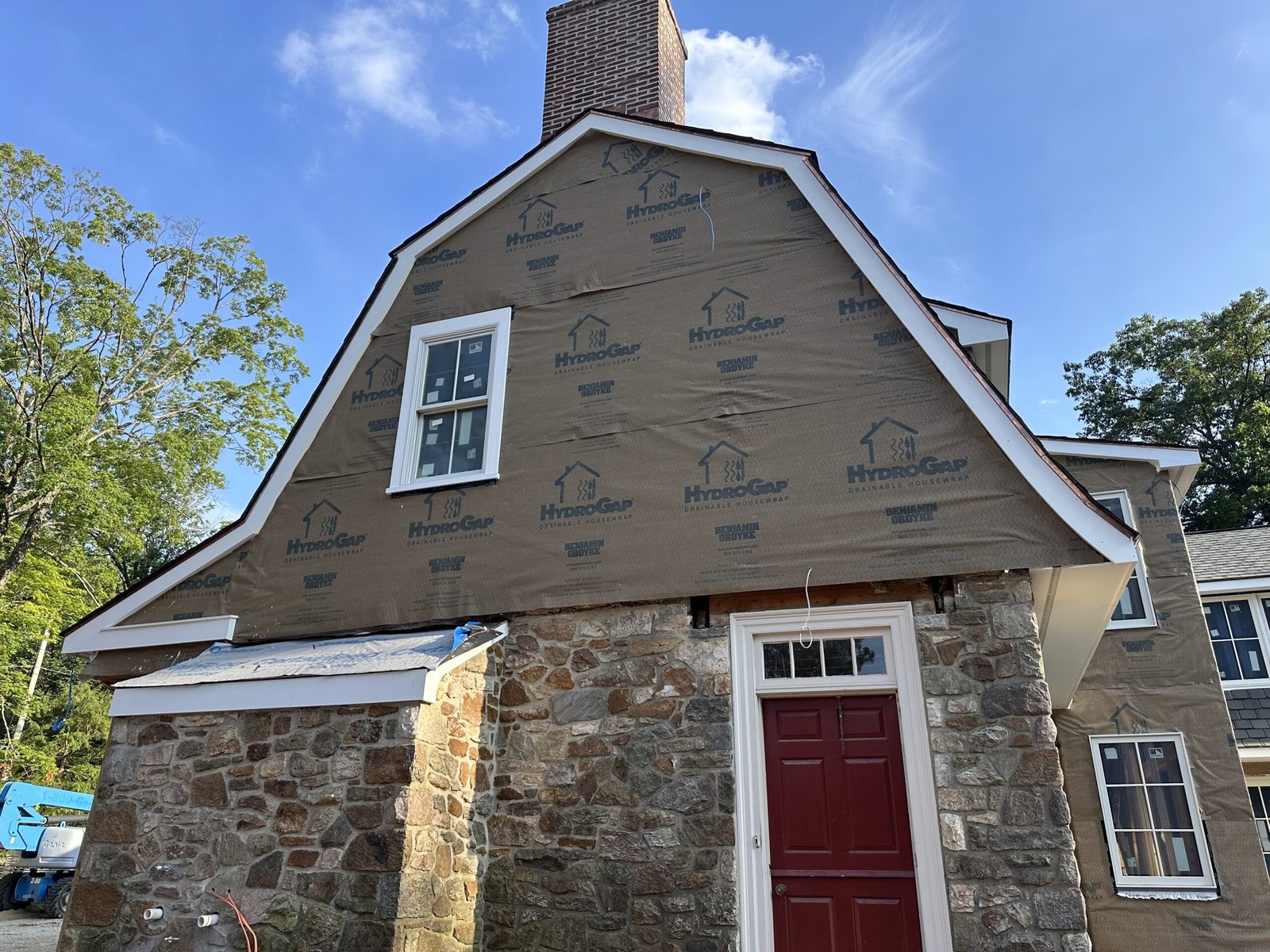

Most project photos show the finished result. This one is from the middle of the job, and that is intentional. What you are looking at is a gambrel-style home in Chester County with a fieldstone first story and a wood-framed upper gable, fully wrapped in Benjamin Obdyke HydroGap drainable housewrap before the new siding goes on. The red entry door is staying. The windows are new. The stone stays exposed. Everything above the stone line gets new siding once the wrap is complete and inspected.
We publish mid-project photos because the work that happens behind the siding is the work that determines how long everything lasts. A finished exterior looks the same whether the installation behind it was done carefully or not. The difference shows up five years later.
This post covers what is happening in this photo, why drainable housewrap matters specifically for a home like this one, and what homeowners in Kennett Square and surrounding Chester County communities should understand before they hire anyone for this kind of project.

The home and what the project involves
The property is a classic Chester County stone home with a gambrel roof and a wood-framed upper gable above a full fieldstone first story. This combination is common in the older residential areas of Chester County, Kennett Square, and down through southern Chester County into the Brandywine Valley. The stone stays. It is structural and aesthetic and does not need to be touched. The upper gable is a different story.
Wood-framed gable walls on homes this age typically have layers of history: original wood siding, possibly a re-side at some point in the 1970s or 80s, and by now a wall assembly that has absorbed moisture, lost continuity in its weather barrier, and needs to be taken back to the sheathing before anything new goes on.
That is what happened here. Old siding came off, sheathing was inspected, and new Benjamin Obdyke HydroGap went on before the new siding is installed.
The scope of this project includes:
- Full removal of existing upper gable siding
- Sheathing inspection and any needed repair
- Installation of HydroGap SD drainable housewrap across the full gable
- Window replacement (already complete in the photo)
- New fiber cement siding over the wrapped gable
- New trim at all wall transitions, including the stone-to-siding line

What HydroGap is and why it matters here
HydroGap is a product made by Benjamin Obdyke, a company based in Pennsylvania that has been manufacturing building envelope products for over 150 years. Their drainable housewrap is different from standard housewrap in one specific way: the fabric has a textured surface that creates a small drainage plane between the wrap and the siding installed over it.
That drainage plane is not a large gap. It is about 1mm of space, enough for water that gets behind the siding to drain down and out at the base of the wall rather than sitting against the housewrap and finding a path through any imperfection in the installation.
On a home like this one, that matters for a few reasons.
The transition between the fieldstone first story and the wood-framed upper gable is a water management challenge. Water running down the gable wall reaches that transition point and needs somewhere to go. If the drainage plane is not working, some of that water ends up sitting at the base of the framed wall section, which is exactly where you do not want it.
The gambrel roof geometry also creates roof planes that shed water onto the upper gable walls in a way that a standard gable does not. More water hits the wall surface on this type of home than on a simple two-story box, and the weather barrier needs to handle that load over the long term.
Benjamin Obdyke publishes independent testing data on HydroGap’s drainage rate and water-resistive performance. Their products meet ASTM E2925 standards for drainable weather-resistive barriers, and the drainage efficiency is independently verified. The Building Science Corporation, one of the most respected research organizations in residential construction, has written extensively on the importance of drainage planes in wall assemblies and why standard non-draining housewrap falls short in high-exposure applications.


The stone-to-frame transition: a detail most contractors overlook
The line where the fieldstone ends and the wood-framed gable begins is the most critical detail on this project. It is the point where two fundamentally different wall systems meet, each with different moisture behavior, different thermal movement, and different failure modes.
Fieldstone does not move much with temperature. Wood framing does. Siding installed across that transition without accounting for the differential movement will develop gaps at the joint over time, regardless of how well it was installed initially.
The correct approach is a proper flashing detail at the transition, integrated with the housewrap above and terminated correctly over the top of the stone. This keeps water that runs down the gable wall from tracking into the joint between the stone and the framed wall, which is exactly where you would expect moisture to enter if the detail is skipped.
This is one of those things that does not come up in a sales presentation. It comes up in the field, during installation, when someone who knows what they are doing looks at the transition and decides how to handle it correctly rather than just moving fast.
Related on this site: How to Tell When Your Siding Needs to Be Removed vs. Repaired covers the indicators that show up when wall assemblies like this one have been losing moisture battles for a while.
Why Chester County stone homes need contractors who have worked on them before
Chester County has a high concentration of fieldstone homes relative to most of Pennsylvania. The Brandywine Valley, the areas around Kennett Square, West Grove, Avondale, and Landenberg, and the older parts of West Chester and Phoenixville all have substantial housing stock built before 1950 with stone first stories and wood-framed upper sections.
These homes require different thinking than new construction or standard frame homes. The walls are thick. The transition details are specific to the construction era. Material choices for re-siding need to account for the weight of the stone below and the visual character of the property. And the contractors who do well on these projects are the ones who have looked at enough of them to know what is likely to be behind the old siding before they open the wall.
Contractors who primarily work on newer construction sometimes approach re-sides on older stone homes as a straightforward production task. On the right property that is fine. On a gambrel stone home in Kennett Square that has been occupied for 80 years, it is not.
Related on this site: Best Home Renovation Contractors Near Terre Hill PA covers how to evaluate any contractor before you hire them, and the same questions apply here.
What to ask a siding contractor in Kennett Square or southern Chester County
These are the questions that matter before you hire anyone for a re-side on an older stone home.
Are you PA HIC registered? Check at the Pennsylvania Attorney General’s HIC Registry before anything else. It takes two minutes.
What housewrap do you use and why? A contractor who has thought about water management will be able to answer this. One who uses whatever is cheapest will either not know the brand or not be able to explain the choice. For a home with significant water exposure, drainable housewrap is the correct product. Standard non-draining wrap is not wrong, but it is the lesser choice on a high-exposure application.
How do you handle the transition between stone and framed walls? This is the key question for a home like this one. There is a right answer and a lot of wrong ones. A contractor who has done this work before will describe a flashing detail. One who has not will give you a vague answer about caulk.
Who does the installation? Ask whether the crew on your project are company employees or subcontractors hired by the job. The answer affects accountability, consistency, and what happens when something needs to be addressed mid-project.
Do you pull permits when required? In Pennsylvania, re-siding permits are required in some municipalities and not others. A contractor who knows the local requirements and handles the permit process correctly is a contractor who is serious about doing the job right.
The Pennsylvania Contractors Association maintains resources for both contractors and homeowners on licensing and best practices in the state.
Other communities in southern Chester County where we work
Kennett Square is the anchor for this post, but our work in Chester County covers a wider area. These are some of the smaller communities in the southern part of the county where we take on siding, window, and exterior renovation projects:
- West Grove, PA – Quiet Chester County borough with older housing stock and very few contractors marketing here specifically
- Avondale, PA – Small community just south of Kennett Square, similar mix of stone and frame construction
- Landenberg, PA – Rural Chester County close to the Delaware line, older homes that have rarely been marketed to by contractors at this level
- Oxford, PA – Larger borough in southern Chester County with steady demand for exterior renovation
- Coatesville, PA – City in western Chester County with a strong base of older masonry and frame construction
- Parkesburg, PA – Chester County borough on Route 30 with older residential neighborhoods and limited contractor competition
We also work throughout Lancaster County from our base in Ephrata, and across the region as projects come up. See the full picture at our services page.
Where this project goes next
Once the HydroGap installation is complete and the flashing details are finished at all transitions, the fiber cement siding goes on over the wrapped gable. The stone stays exposed on the first story. The trim at the stone-to-siding transition gets installed last, after the siding is in place, so it can be fitted correctly to the finished conditions rather than to a dimension on paper.
When it is done, the house will look like a properly restored Chester County stone home: stone first story, clean new siding above it, good trim details at every transition, and a wall assembly behind the siding that is actually going to perform for the next few decades.
We will post the finished photos when the project wraps up.
If you have a similar project in Kennett Square, West Grove, or anywhere in Chester County or Lancaster County, we are glad to come out and give you a straight read on what it involves.
Related posts: