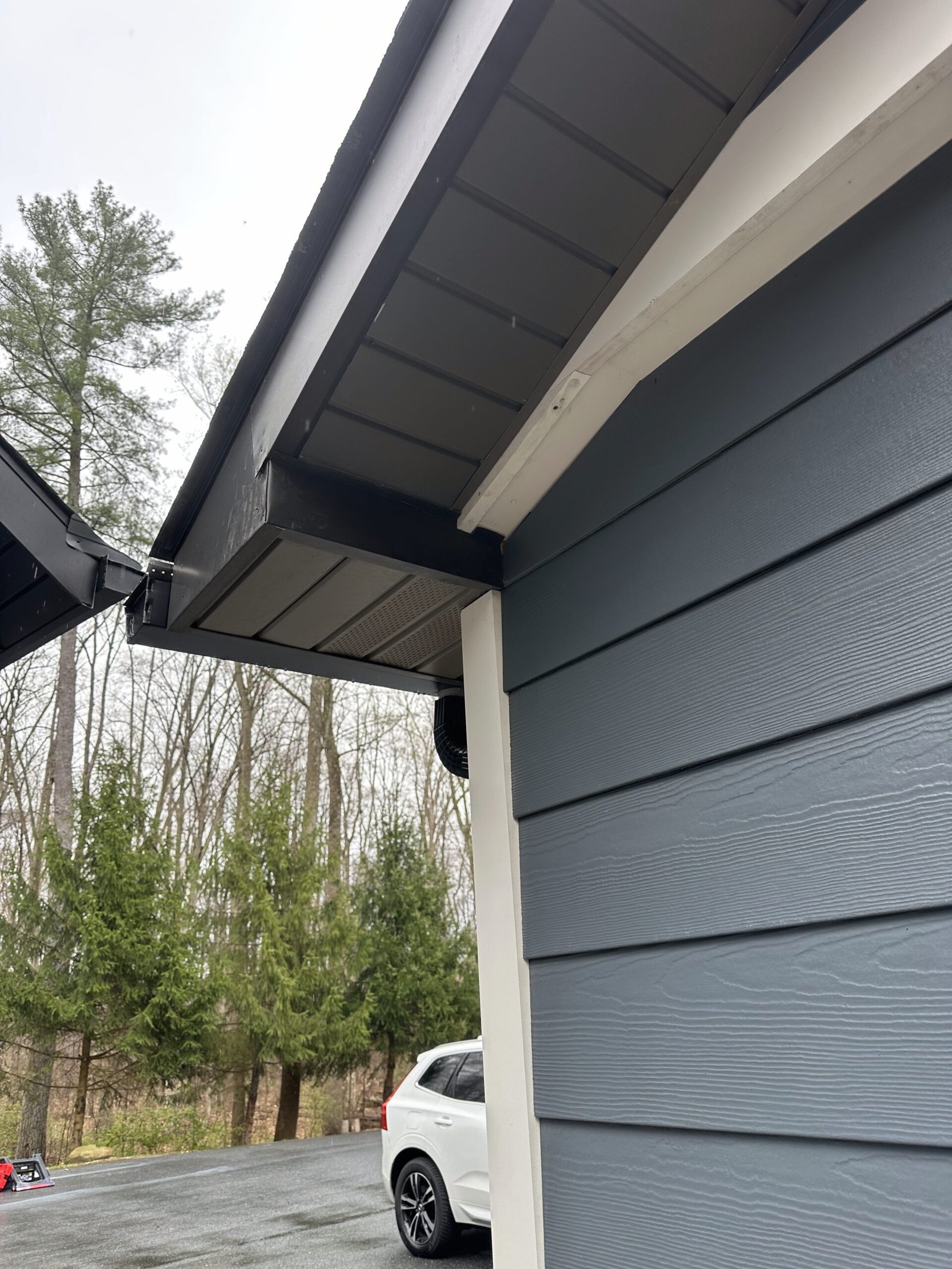

This project came together well. Dark charcoal gray fiber cement lap siding, white corner boards and window trim, black gutters running clean down the corner, and shake accent panels between the garage and the main wall. The homeowner wanted something that looked modern and held up without a lot of ongoing maintenance. Fiber cement was the right call, and the color combination they chose is one of the better ones we have installed.
Denver, PA sits in northern Lancaster County on Route 272, and it is the kind of town where most contractors are not writing about the work they do there. That is fine with us, because it means when someone in Denver or Adamstown or Reinholds searches for siding help, there is not much competition for that attention.
This post covers what went into the project, why fiber cement makes sense for Lancaster County homes, and what to look for when you are evaluating contractors for this kind of work.
What the project included
The scope was a full exterior re-side on a residential garage structure with an attached addition. The existing siding had reached the end of its useful life: paint was peeling, a few panels had absorbed moisture along the bottom edges, and the overall appearance had fallen well behind the rest of the property.
The work included:
- Full removal of the existing siding and disposal
- Inspection of the wall sheathing and framing beneath
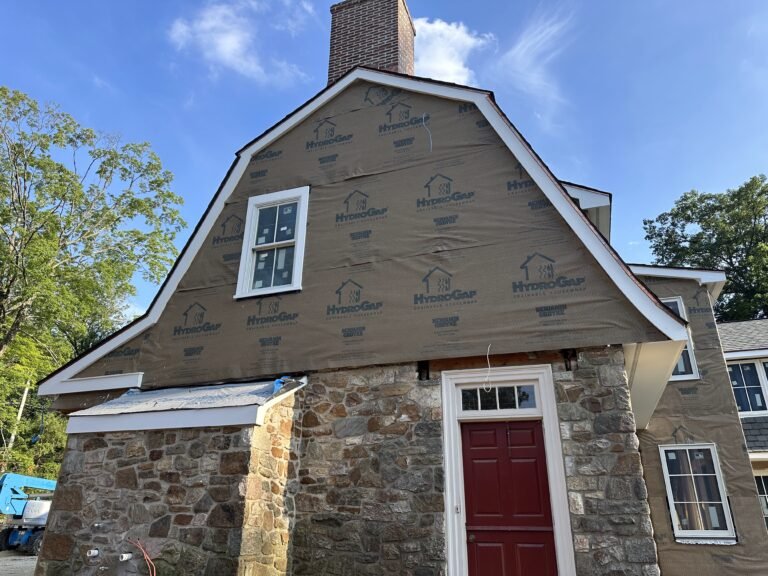
- Installation of new house wrap over the full exterior
- James Hardie lap siding in Midnight Black, installed with manufacturer-specified fasteners and gaps
- White primed fiber cement corner boards, window trim, and frieze
- Shake panel accent on the garage corner column
- Coordination with the gutter crew for the black K-style gutters
The sheathing was in good shape. No surprises once the old material came off, which is always a good day on a re-side.

Why fiber cement holds up in Lancaster County
Lancaster County weather is not dramatic by Northeast standards, but it puts real wear on exterior materials over time. Winters bring freeze-thaw cycles. Summers bring extended humidity and UV. The spring and fall seasons have consistent rain. All of that together is hard on wood, vinyl, and anything that relies on a painted finish to keep moisture out.
Fiber cement handles those conditions better than most alternatives. It is made from a mixture of cement, sand, and cellulose fiber, and the result is a material that does not rot, does not support mold growth, is not attractive to insects, and does not expand and contract with temperature the way vinyl does. The finish is baked in at the factory, not applied over a substrate that will eventually fail.
James Hardie, the manufacturer used on this project, publishes independent performance data and backs their product with a 30-year non-prorated warranty on the siding and a 15-year finish warranty on their prefinished ColorPlus line. Their products are rated by the National Institute of Standards and Technology and tested under ASTM standards for impact resistance, moisture resistance, and dimensional stability. That kind of testing record matters when you are making a decision that affects your home for the next few decades.
For Lancaster County homeowners specifically, fiber cement is also a good match for the housing stock. A lot of homes here were originally sided with wood, and fiber cement installed with appropriate trim details gives you the look of painted wood clapboard without the maintenance cycle.
Related on this site: How to Tell When Your Siding Needs to Be Removed vs. Repaired covers how to evaluate whether your existing siding can be patched or whether a full replacement makes more sense.

The color decision
This homeowner went with a dark charcoal, close to James Hardie’s Midnight Black, paired with white trim boards throughout. It is a combination that shows up a lot right now in residential design, and for good reason: the contrast reads as intentional and current rather than dated, and dark siding tends to minimize the visual noise of different wall planes and angles.
A few things worth knowing if you are considering a similar palette:
Dark siding absorbs more heat than light siding. In full southern or western sun exposure, this can increase surface temperatures and in some cases accelerate paint fade on lighter-colored trim. For this project the exposure was mostly northern and eastern, which made the dark color a reasonable choice without a significant thermal tradeoff.
The white trim on dark siding has to be installed cleanly. There is no hiding a gap or an uneven corner board when the contrast is this high. Every joint, every miter, every trim intersection needs to be done right the first time. That is not a problem for an experienced crew, but it is a reason why this kind of project rewards hiring someone who has done it before.
What a proper fiber cement installation requires
Fiber cement is not difficult to install, but it is unforgiving of shortcuts. The material is heavier than vinyl, it needs to be cut with the right tools to avoid fiber release, and the fastening schedule matters more than it does with some other products.
These are the steps that separate a careful installation from a fast one:
House wrap or weather-resistive barrier. This goes on before any siding. It is the line of defense against water that gets behind the siding panels. The International Residential Code requires it, and skipping it or doing it sloppily is the single most common cause of moisture problems behind new siding. We install it on every job.
Correct bottom clearance. Fiber cement panels need a minimum clearance from grade, roofing, and flashing to prevent wicking moisture at the cut edges. Manufacturer specs call for specific clearance minimums depending on the surface below. Panels installed too close to grade will fail at the bottom edge long before the rest of the siding shows any wear.
Fastener type and placement. James Hardie specifies galvanized or stainless steel nails or screws, driven to specific depths. Fasteners that are overdriven break the surface and create entry points for moisture. Fasteners that are underdriven leave the panel loose and allow it to move with temperature changes.
Gaps at joints and trim intersections. Fiber cement expands and contracts slightly with moisture content. Panels installed butted tight against each other or against trim will buckle when they pick up moisture during wet weather. Correct gaps get caulked with a flexible paintable caulk that maintains the seal through movement.
Primed cut edges. Any cut edge on fiber cement needs to be primed before installation or on site if the cut is made during installation. Unsealed cut edges absorb moisture and degrade faster than factory edges.
The James Hardie installation guide covers all of these requirements in detail, and it is a useful reference for any homeowner who wants to verify whether a contractor is following correct procedure.
What to ask a siding contractor in Denver or Lancaster County
The siding market in Lancaster County has a lot of contractors competing at a wide range of price points. As with most home improvement categories, the cheapest option usually reflects something: faster installation, skipped steps, subcontracted crews, or lower-grade material. Here is what to ask before you hire anyone.
Are you PA HIC registered? Check any contractor through the Pennsylvania Attorney General’s HIC Registry before you go any further. No registration, no conversation.
Are you a James Hardie preferred contractor? James Hardie runs a contractor certification program called Hardie Contractor, which requires training on correct installation practices. It is not the only mark of a good installer, but it is a useful filter. Certified contractors are listed on the James Hardie contractor locator.
Who does the work? Many siding companies sell the job and subcontract the installation. Ask directly who will be on your property each day and whether they are employees of the company you are hiring or independent contractors working for a day rate.
How do you handle house wrap and flashing? Same question that applies to window and door installation. The answer tells you how much the contractor thinks about water management versus just putting panels on walls.
What does your workmanship warranty cover? The manufacturer warranty covers the material. Your contractor’s warranty covers the installation. Get both in writing.
Other small Lancaster County towns where we work on siding
Denver is our anchor for this post, but we cover the full county and work regularly in communities around it where there is real demand and very little contractor presence:
- Adamstown, PA – Right on the Lancaster-Berks County line, older housing stock, consistent need for exterior work
- Reinholds, PA – Small residential community in northeastern Lancaster County, almost no siding contractors marketing here
- Reamstown, PA – Quiet residential area near Denver with similar housing types
- Terre Hill, PA – Eastern Lancaster County community with older homes that have been waiting for proper re-sides for years
- Goodville, PA – Rural community between New Holland and Blue Ball, essentially no competition for this type of work
- Brickerville, PA – Small community near Lititz where we handle both exterior and interior renovation projects
We are based in Ephrata and drive to all of these towns regularly. If you are not sure whether we cover your area, just get in touch and ask.
The finished result
The project came out exactly as planned. Clean lines, consistent reveal on every course of lap siding, tight trim at every corner and window opening, and a color combination that makes the whole structure look like a different building than it was before.
That is what a siding project should do: not just replace worn material, but improve what the property looks like and how it performs for years forward.
If you have siding that needs attention in Denver, Adamstown, Reamstown, or anywhere else in Lancaster County, we are glad to come out, look at what you have, and give you a straight answer on what it would take to do it right.
Related posts: