
The worst exterior problems are the ones you cannot see. Water damage behind siding repair in Ephrata PA almost always starts as something small and invisible, a hairline gap at a window, a strip of failed caulk, a missing piece of flashing. Water finds it, slips behind the cladding, and goes to work on the sheathing and framing where no one is looking. The siding still looks fine from the street while the wall behind it slowly gives way.
D&E Mako Renovation opens up these walls regularly on homes around Ephrata, Akron, and Denver, and the story is usually the same. The owner had a small clue for months, a stain or a soft spot, and did not connect it to a bigger problem. This guide is about reading those clues early, before a cosmetic issue becomes a structural one.

What this guide covers
- The interior signs that point to water getting in behind your siding
- The exterior tells, from failing caulk to gaps at window trim
- What contractors actually find once the siding comes off
- Why early detection saves you from a structural repair
- How to tell normal weathering from a real moisture problem
Why water damage behind siding stays hidden so long
Siding is a shedding layer, not a sealed one. It is designed to keep most water out and let the wall dry when a little gets in. That system works until a detail fails and water gets trapped against the sheathing with no way to dry. From the outside everything looks normal. The damage happens in the cavity, and by the time it reaches the surface it has usually been going on for a year or more.
The path water takes
Water rarely enters where the damage shows. It comes in high, at a window head, a flashing gap, or a roofline, then runs down the back of the sheathing and pools at the bottom of the wall or at the next horizontal break. That is why a stain at the floor can come from a leak six feet up. Following the water back to its source is the whole game.
Worth knowing: A musty smell near an exterior wall with no visible leak is one of the most reliable early signs. Your nose catches trapped moisture before your eyes do.
The hidden signs of water damage behind siding
Some of these show up inside the house, some outside. Together they build a picture. One on its own might be nothing. Two or three pointing at the same wall is a reason to look closer.
Sign 01
Stained or bubbling interior walls
Yellow-brown stains on drywall, paint that bubbles or blisters, or wallpaper lifting at a seam on an exterior wall all point to moisture coming through. If it lines up under a window or near an outside corner, the source is very likely behind the siding on that wall.
Sign 02
Failed caulk around windows
Caulk is not permanent. After years of freeze-thaw, the bead around windows and trim cracks, shrinks, and pulls away. Those open joints are direct entry points. Failing caulk around windows is one of the most common reasons we get called, and it is far cheaper to address before water has been getting in for seasons.
Sign 03
Gaps between siding and window trim
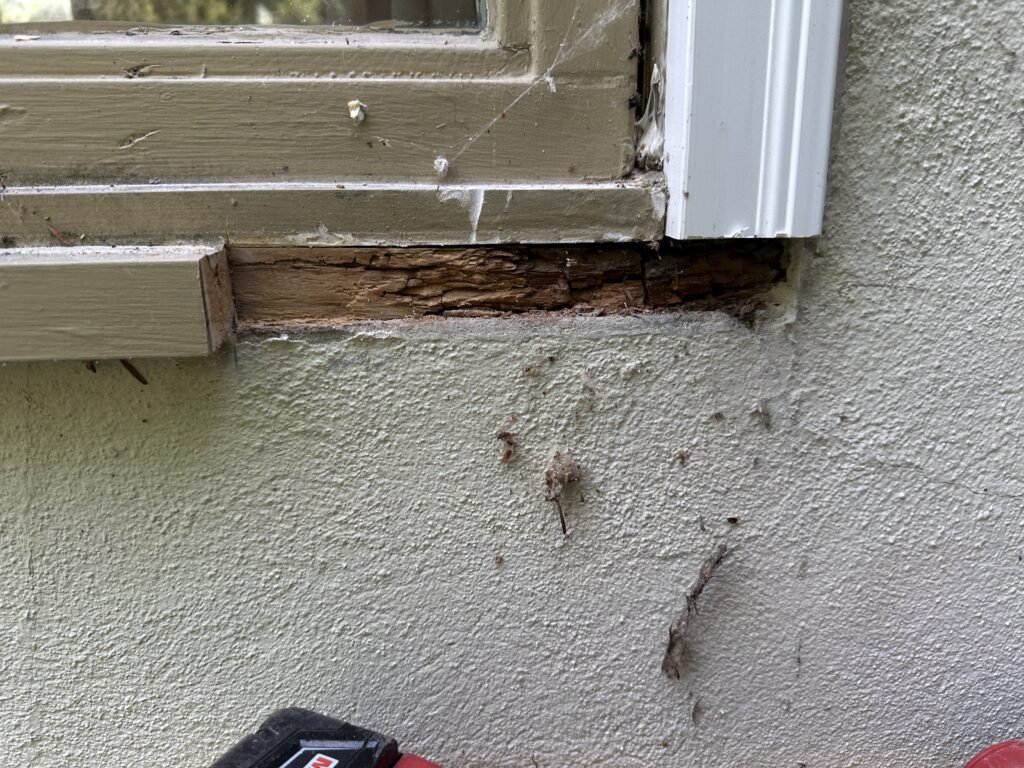
When you see daylight, shadow lines, or open gaps between siding and window trim, the assembly has moved or was never sealed correctly. Wind drives rain straight into those gaps. This is a flashing and integration problem, not just a caulk problem, and it usually needs more than a tube of sealant to fix right.
Sign 04
Soft, spongy, or bulging siding
Press on the siding near a suspect area. If the wall behind it feels soft, or the siding bulges, waves, or has loosened, the sheathing underneath may already be saturated and failing. This is the stage where a cosmetic problem has become a structural one.
What water damage behind siding repair in Ephrata PA involves
Once the signs add up, the only way to know the extent is to open the wall. Guessing from the outside underestimates it almost every time.
What we find when the siding comes off
Behind the siding we commonly find darkened or crumbling sheathing, rusted fasteners, mold on the back of the cladding, and in the worst cases soft framing. The water-resistive barrier, the layer that is supposed to protect the sheathing, is often torn, missing, or installed without the proper laps. The building envelope research at Building Science Corporation explains why those drainage and barrier details matter so much, and why skipping them leads straight to the failures we see.
Why early detection changes everything
Caught early, the fix can be as targeted as resealing, re-flashing a window, and replacing a small area of cladding. Caught late, it means removing siding across an elevation, replacing sheathing, treating or replacing framing, and rebuilding the moisture barrier from scratch. Same starting cause, very different scope. Our guide on when siding needs removal versus repair breaks down where that line falls, and why siding peels and how a contractor fixes it covers a related surface symptom.
Worth knowing: If you are already planning to repaint or reside, that is the ideal moment to inspect the wall behind. The siding is coming off anyway, so the labor to check the sheathing is essentially free at that point.
When repair calls for opening and rebuilding a wall, that work falls under our siding installation and repair service, where we address the cause, not just the cladding.
Where D&E Mako Renovation works across Lancaster County
Lancaster County service area
- Ephrata, PA — our home base, where older walls hide years of slow moisture damage
- Akron, PA — borough homes where window caulk has long since failed
- Denver, PA — a mix of homes with flashing details that predate modern standards
- Reinholds, PA — exposed rural sites where wind-driven rain finds every gap
- Stevens, PA — homes where interior stains turned out to be exterior leaks
- Adamstown, PA — older construction where the moisture barrier has aged out
If your project is outside these areas, get in touch through our contact page and we will let you know whether it falls within our range.
The short version on water behind siding
Water damage behind siding repair in Ephrata PA is mostly a detection problem. The damage is hidden by design, so you have to read the small signs: interior stains, bubbling paint, failed caulk, gaps at the trim, and soft spots in the wall. Any of those near an exterior wall is worth a closer look.
The difference between a minor repair and a wall rebuild is almost entirely timing. The homeowners who catch it early spend the least. The ones who wait until the siding is bulging spend the most. When the signs line up, open the wall and find out for sure.
Seeing stains, soft spots, or failed caulk? We will find the source before it spreads.